DAY 4: The treasure hunt
With the help of technology and an old amnesiac pirate, the crew finds the treasure and the key to open it.
1. Introductory unplugged activity
Draw a treasure map (inpired by RTP Unseen Structure)
- The crew members have to find the map to the treasure based on the instructions from an old amnesiac pirate.
- Once they find where the map is located (in a dark cave) the group is divided into two teams.
- Every team sends a scout to check the map in the cave. The scout has only 3 seconds to look at the map and help his team reproduce the map correctly. (We light the cave with a candle for few seconds)
- Once every kid has gone to the cave and the map is complete, the two teams compare their maps.
Feed back of tests with KCJ team (21-06-2018):
+ Very good feedback. Include darkness and a candle light for 3 seconds to visualize maps.
+ Simplify the Map for the Kids
2. Microbit activity
+ TODAY WE LEARN:
1. What is a radio frequency/group/channel?
2. What is a variable in code?
3. Work as a team to achieve a collective goal
2.1 Blocks Code
2.1.1
In this activity kids creat a collective work using the radio to pass message from one microbit to the next. They have to make up a story or a song of their choice as a team. Everyone has to have to right code for collective artwork to work.
*** PLEASE ADD THE DEMO CODE FOR THE INTRODUCTION TO RADIO (microbit-radio-colletive.hex in ./Makecode/Final/day4)***
2.1.2 The treasure detector
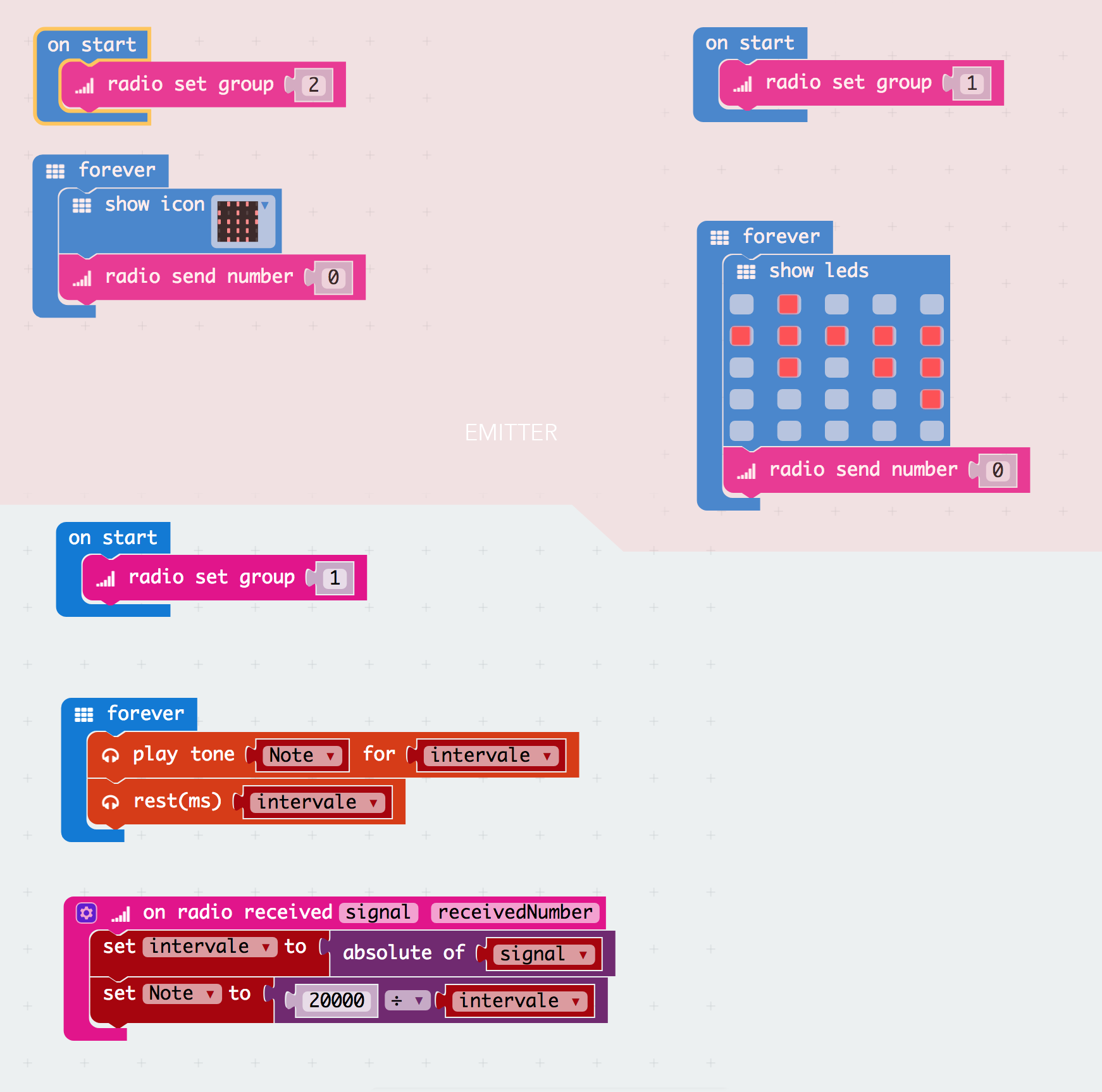
One MicroBit with radio to find the are where the treasure is found - General.
This code is very similar to the one for the fish finder in day 2.
2.2 Text Code
Emitter
radio.setGroup(2)
basic.forever(() => {
    basic.showIcon(IconNames.Skull)
    radio.sendNumber(0)
})
Reciever
let Note2 = 0
let intervale = 0
radio.onDataPacketReceived( ({ signal, receivedNumber }) =>  {
    intervale = Math.abs(signal)
    Note2 = 20000 / intervale
})
radio.setGroup(2)
basic.forever(() => {
    music.playTone(Note2, intervale)
    music.rest(intervale)
})
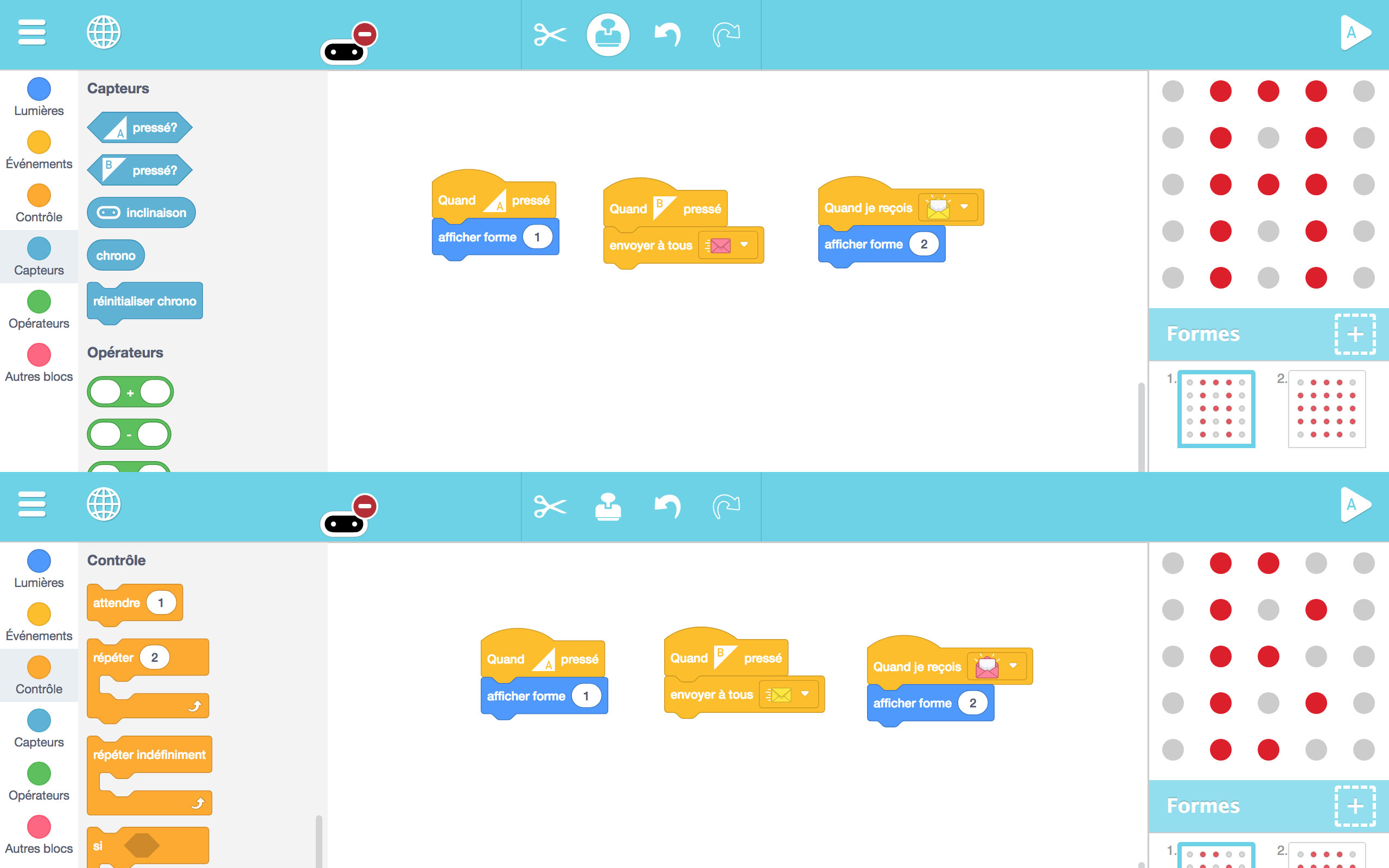
2b. Artbit - begginers - messages
+ TODAY WE LEARN:
1. What is a message?
2. How can send messages?
3. Play with the message program and see how affects the pixel art image.
- Create their own Message send in Artbit - We send a Pirate coin!
3. The treasure detector
The crew programs their microbit to send radio signals of various strenghts so their microbit can be used as a range finder. With the help of their map and their special treasure detector, they can now hunt down the treasure.
- One team is sent to find the key and the other is sent to find the treasure chest.
- The range finder produces a sound which freqency increases with decreasing distance from the target.
- Once the team is very close to the target, they switch detection mode to detect the exact location of the target using a amgnetic field detector.
Feed back of tests with KCJ team (21-06-2018):
+ Very good feedback. The Radio signal worked as expected within the programmed ranges.
+ Option of giving many Microbits with different sounds could be confusing.
+ Amplify the sound
4. Conclusions
Young kids (age 5 to 8)
- Unplugged Activities
We introduced kids to what is a map and its symbols. The idea was that they start to understand what a map is, how it is an abstraction of the reality from the top view and how easy it is to identify objects on it. The results were fun and interesting.
- Coding
They continued with their animations. With the first batch of kids that used microbits music was added to the mix. With the second batch of the kids artbit did not allowed us to add music and we experimented with some panning camera moves.
- Taking the code out
This game worked really well. This time we created two groups of about 7 kids. We gave them a microbit each and challenged them to find the treasure. We first made a demo of how to detector works by making them listen to changing sound of the microbit as the instructor gets closer with the emitter. The instructor then hides the emitter. The little kids loved to go out with the beeping microbit in search of the treasure. The kids had to find a KEY and a SKULL representing the treasure to have success. With a little help and the detectors they very well accomplished it!. Once the tresure was found, we proceeded to the distribution of the treasure (plastics gems and golden coins).
OBSERVATIONS:
Older kids (age 8 to 12)
- Unplugged Activities
The memory game was a success. Both teams had fun memorizing the map and localizing the treasure. This is a game that we recommend alongside with the architect and the secret object as unplugged activities.
- Coding
In this class we opened the class to experimentation in radio communication. We teach them the basics about how to send a message and after that we designate some 'leaders' in the class to help create a series of images and sounds along all the microbits through sending messages in different channels. We enjoyed the game a lot, we would just recommend to choose the 'right' leaders and maybe create a very well defined objective so they have to take less decisions and keep focus on the activity. Giving the kids responsability was a great idea. From that point on they were on their own and they had to cooperate all together to accomplish the objectives. We observed very interesting dynamics. We found that with a little structure, it is possible to give the kids power and responsability on the problem solving process.
- Taking the code out
The treasure hunt was a success with this gae group too. We made the reserach a little more challenging for them.
OBSERVATIONS:
Authors: B.Ferragut and D.Banville - June 2018
© 2012 - 2018 Kids Code Jeunesse | All Right Reserved